Local author Sandra Moore pens children’s book about Japanese culture, Hiroshima and a bonsai tree.
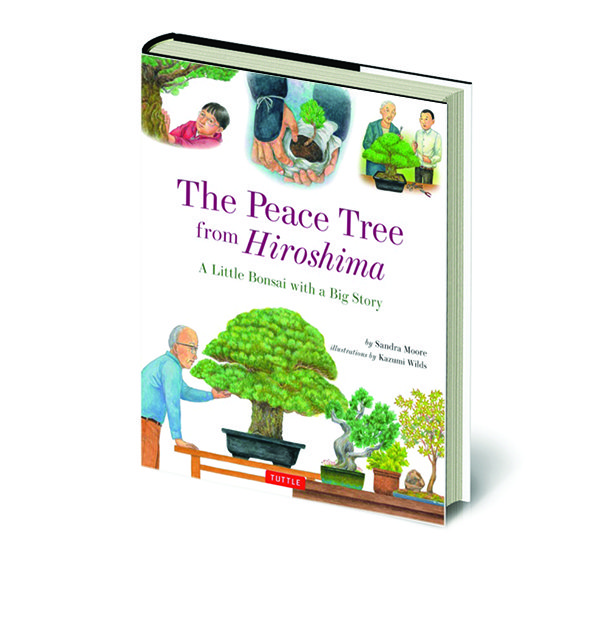
“The Peace Tree from Hiroshima” follows the very real journey of a bonsai tree from its growth on the Japanese island of Miyajima over 400 years ago to the bombing of Hiroshima during World War II and finally to its display at the National Arboretum in Washington, D.C., in 1976, where it can still be seen today. Author Sandra Moore talks with Northern Virginia Magazine about the book and what drew her to this particular story.
Q: What made you decide to write this book with this particular narrative?
A: When I went to the National Arboretum, I went on a tour of the bonsai collection, and I immediately fell in love with it. The curator of the collection, Jack Sustic, told the story about the oldest tree in their collection; at that point it was 400 years old, and that was really amazing. The fact that the same family took care of the tree and handed down the responsibilities of caregiving from generation to generation for six generations was really impressive. The part of this story that was really eye-opening was when I found out that the tree was on a porch of a house in Hiroshima when the atomic bomb was dropped. It was really only because of the peculiarities of the way their porch was built that the tree survived. There’s a word, hibakusha—it refers to people who survived Hiroshima. That’s what happened to this bonsai tree. I was just also so amazed by the family who had become so attached to this tree and then donated it to America.
Q: How did you decide to make the story from the point of view of the bonsai tree?
A: I started out writing the story from the vantage point of the curator at the Arboretum, who first told me the story. But I didn’t think that would be interesting for kids. Another version of the story was written from the point of view of the little boy and his grandfather, whose family owned the tree, going to the U.S. to visit the National Arboretum. But then I was reading the obituary of a very famous bonsai master who was affiliated with the Brooklyn Botanical Gardens. There’s this really great quote from him, “If you listen to the trees, they’ll tell you want they need.” It’s when I heard that that I got the idea to write from the point of view of the tree.
Q: Was there any hesitation in including the bombing of Hiroshima in the book because it’s such a dark topic for children?
A: Yes, I was concerned about that because the book is for a young audience, but I think the book is really meant for an older elementary school audience. I don’t think it’s appropriate for kindergarteners. I would be concerned about sharing this with too young of an audience. But I felt like if the illustrator and I worked together on the language and the way we presented the atomic bombing and used it as an example of the loss that people experienced instead of talking about the scarier and more horrific aftermath of the bomb, we could manage it. We felt like kids who are a little older could cope with that and handle it.
Q: Considering the We Need Diverse Books Initiative, which pushes the publishing industry to publish more diverse books, how do you think children’s books are faring when it comes to diversity? Were you thinking about diversity when writing this book?
A: I love that the We Need More Diverse Books campaign was launched. There are so many authors and illustrators with diverse backgrounds who are writing great manuscripts. We’re finally starting to see more diversity in the industry. As a Caucasian American woman, I knew that I would only be comfortable working with a Japanese illustrator and with a publisher that had a record of publishing diverse books in order to make the story authentic.
(September 2015)