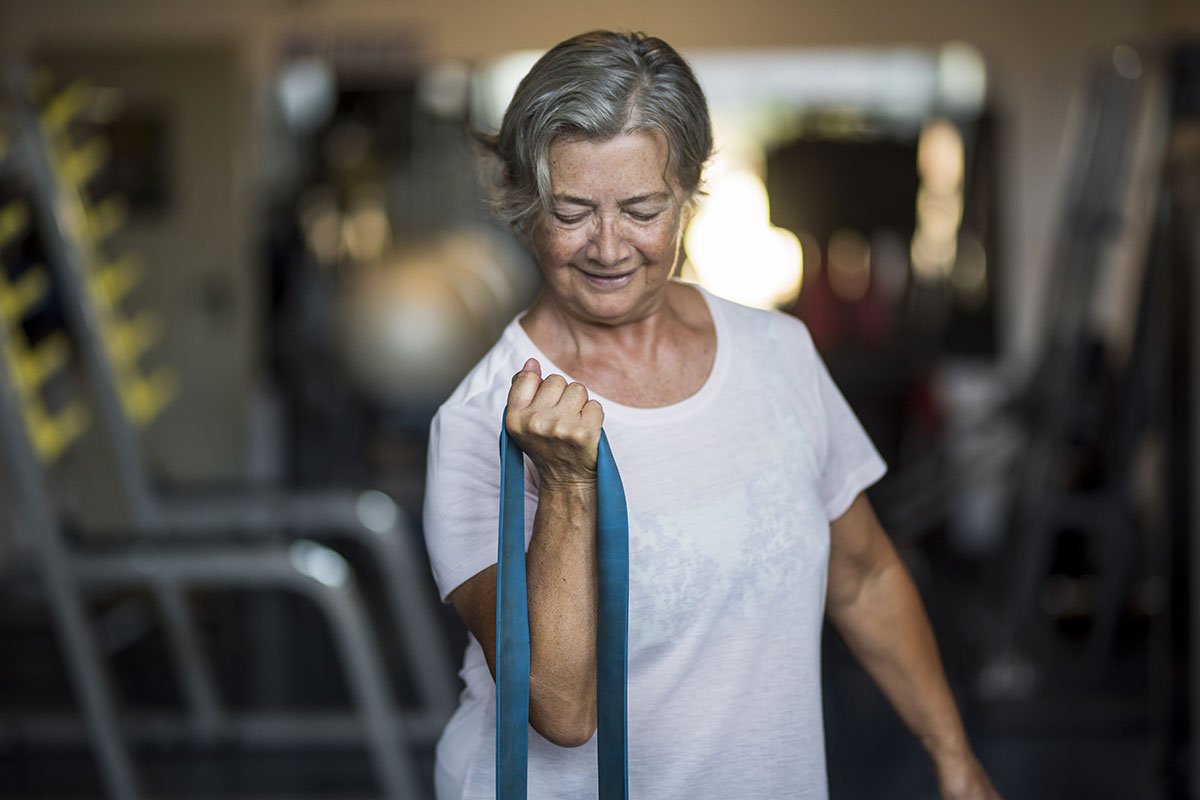
Getting up to start the day with an early-morning workout may be part of your routine, but for others, it may be vital to maintaining their ability to move around in the first place.
Parkinson’s disease is a neurodegenerative disorder that, over time, causes muscular tremors, bradykinesia (slowness of bodily movements), limb rigidity and gait and balance problems. Experiences of those diagnosed with the life-changing disease vary from person to person, yet clinical studies have shown promise of maintaining strength and quality of life through exercise as the disease progresses.
In order to better understand what exercising should look like with Parkinson’s disease, we spoke with local personal trainer and site director of Explosive Fitness Reston at OneLife Fitness. Gunther teaches a weekly class with local Parkinson’s residents and individual training sessions, and takes pride in providing a form of wellness through movement and exercise. Highlights from our conversation are below.
How did you get started with Parkinson’s disease training, and what type of workouts do you teach?
It began when I started working with a gentleman, Russ Sorenson, at the gym who has Parkinson’s disease when I began training at Reston, and that eventually led me to leading the class a year or so later. It’s cool teaching both. Russ and two other trainers in the gym created the [Parkinson’s] class because there was such a need in our area for a class. In both the group and personal setting, I focus on being able to pick up the feet, and get up off of the floor, improving coordination, strengthening the core, moving linearly and laterally, focusing on improving posture and having fun. With personal training and smaller group training, I can dive deeper into specific movements and form a program more toward the individual’s needs. I work with about six individuals from class in the personal or small group setting outside of class.
How does Parkinson’s training differ from more generalized workouts?
There’s not much of a difference. The goal in training anyone and any group is to do no harm, so I like to introduce new things slowly so they do it correctly and can receive the most benefit. The biggest difference between the Parkinson’s disease group and general sessions is that I tend to focus more on coordination and motor control with the Parkinson’s disease group. Being able to do two things at once, while talking, while following my lead, can be challenging. In the group setting, I tend to focus on movements that they do in their everyday life, such as walking, bending over to pick something up, reaching up to grab something, among other staple movements. This way, I can get the most out of class without making anyone uncomfortable. There are different levels of mobility, strength, proprioception (knowing where you are in space), coordination and ability to balance, all across the class. Finding a happy medium is key!
How often should Parkinson’s clients be working out each week?
Ideally, people with Parkinson’s should be exercising three times a week or more. If they’re not at that level, they should start slowly to make sure their bodies are adapting properly. If they’re not exercising at all, work up to consistently exercising once per week; if they’re exercising once per week, work up to twice, and so on.
How do you cope with teaching individuals of varying levels of fitness and the disease?
It’s interesting! We have a very wide range of group members; we have people who you’d never suspect have it, people who have had Deep Brain Stimulation (DBS) surgery to reduce the symptoms of Parkinson’s disease, people who have been diagnosed for a decade, people who have been diagnosed for a year, people that are high fall risk, and more. I want everyone to work at their level and not anyone else’s. There’s a lot to take into account, each day is different for everyone. Knowing how a person is doing that day, when their off-periods are, what medication they’re on, if they’re changing medications and what their limitations are is vital to having a successful class.
Why is it important for people with Parkinson’s to continue to work out and stay active?
The benefits of exercise are endless if prescribed the right way! Exercise can help revamp connections in the brain that would be lost due to Parkinson’s disease, help fight fatigue, improve gait, balance and sleep, among many other areas of life. If they’re not ready for an intense exercise program, simply getting up and walking more is much better than no exercise at all.
If you were to convince someone to come to a Parkinson’s workout who might be hesitant or nervous, what would you tell them or how would you try to convince them?
Many studies have shown that exercise can definitely help those living with Parkinson’s disease. It could help steady the symptoms of Parkinson’s disease, improve their strength to make everyday life easier and positively impact their hormone levels to help them live healthier, happier lives.
What’s your favorite part about getting to teach the Parkinson’s group and individuals?
My favorite part of working with the group is seeing them improve at exercises we practice in class. As they learn from me, I also learn a lot being around them. On the first Monday of each month, we gather and have a roundtable discussion about things they currently experience, medications they take, doctors appointments—things they encounter on a day-to-day basis. Everyone with Parkinson’s disease is different, so I feel it’s important to talk to others that have the disease to see how others live. We’ve had great discussions about their experiences with different medications they take and what they’ve spoken about with their doctors to get the absolute most out of their care.
For more local health coverage, subscribe to our weekly Health newsletter.