In spring of 1789, before his inauguration as the first president of the United States, George Washington traveled to Fredericksburg for what would be a final visit with his mother, Mary Ball Washington. That August, Mary died of breast cancer at 80 years old.
A widow since 1743, Mary had raised George and his younger siblings alone in Fredericksburg, staying single to protect her children’s inheritance. She lived her final years in a small house adjacent to her daughter Betty’s estate. Within walking distance was a large outcropping, now called Meditation Rock, where Mary would frequently go to pray. When Mary died, she was buried near Meditation Rock.
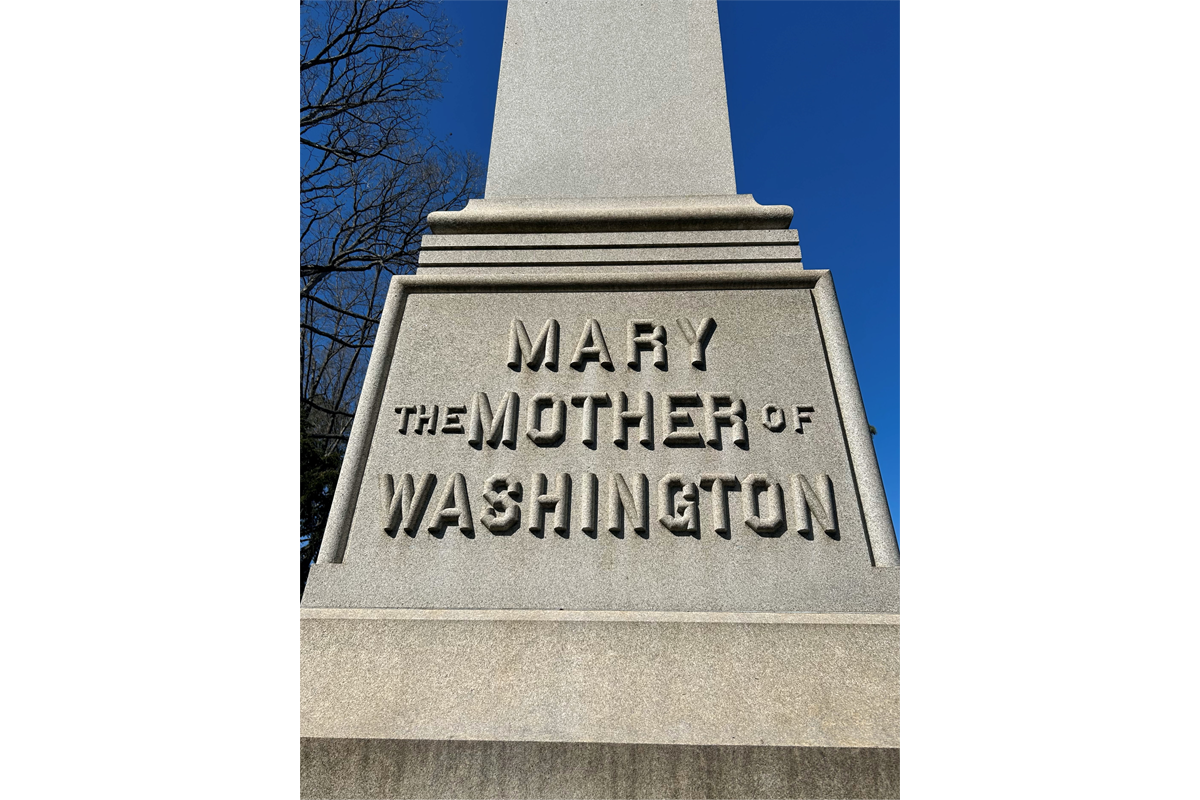
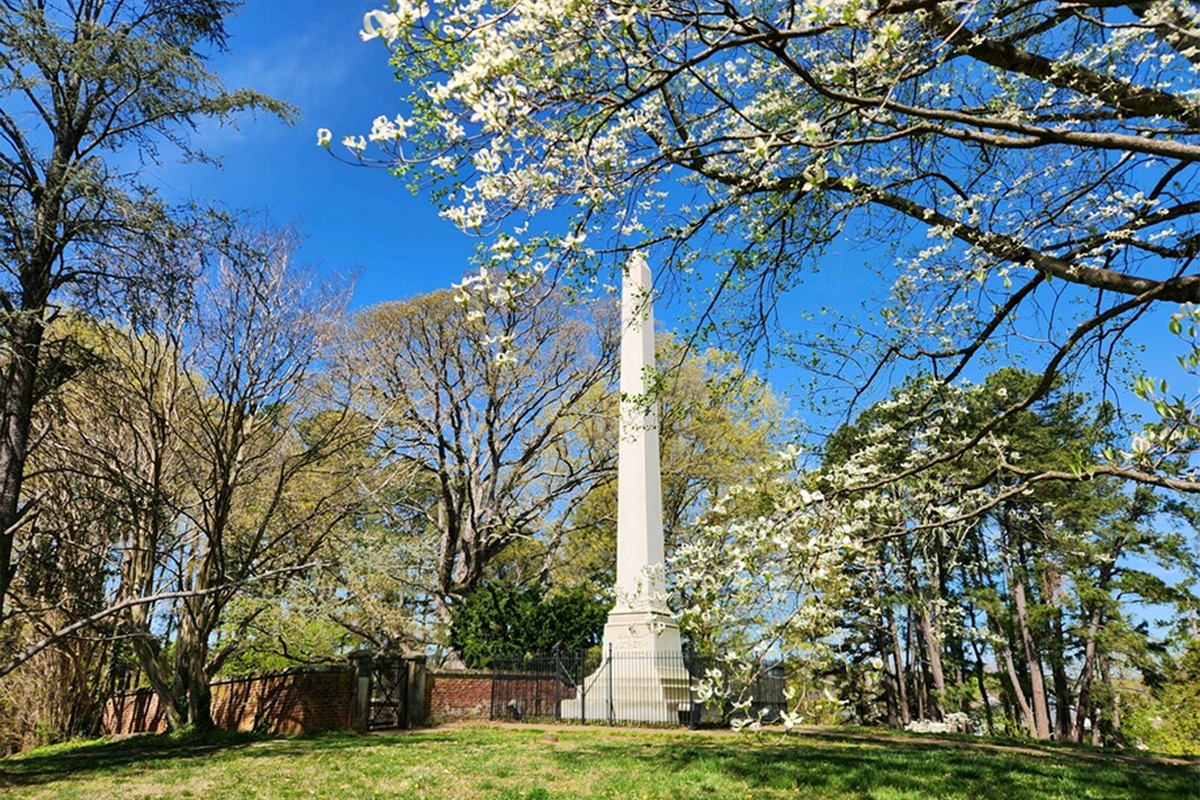
“George Washington did not receive word of his mother’s death until the evening of September 1, 1789,” says Michelle Hamilton, manager of Mary Washington House, one of four 18th-century house museums in downtown Fredericksburg owned and operated by the nonprofit, Washington Heritage Museums. If George ordered a marker, there is no record of where it was placed. The current monument that honors Mary, a tall obelisk near Meditation Rock, was erected in 1894, more than a century after her death without knowing the exact location of her remains.
The Need to Know
“People have been curious about Mary’s burial site for a long time,” notes WHM Executive Director Anne Darron. In 2023, the city gifted the monument and its adjacent Caretaker’s Lodge to WHM. Darron says the organization has practical reasons to search for Mary’s remains. “We are renovating the Caretaker’s Lodge and changing the monument’s landscape to create more accessible pathways, and we don’t want to impact or disturb Mary’s gravesite,” she says. The Caretaker’s Lodge will eventually house a small museum and WHM headquarters. The multi-year fundraising goal for the project is $1.6 million.
“We learned last year that the University of Mary Washington was hiring a new professor and would be getting ground-penetrating radar equipment, so the timing was fantastic,” says Darron. “We had this need, and UMW had new GPR equipment that they wanted to train students how to use.”
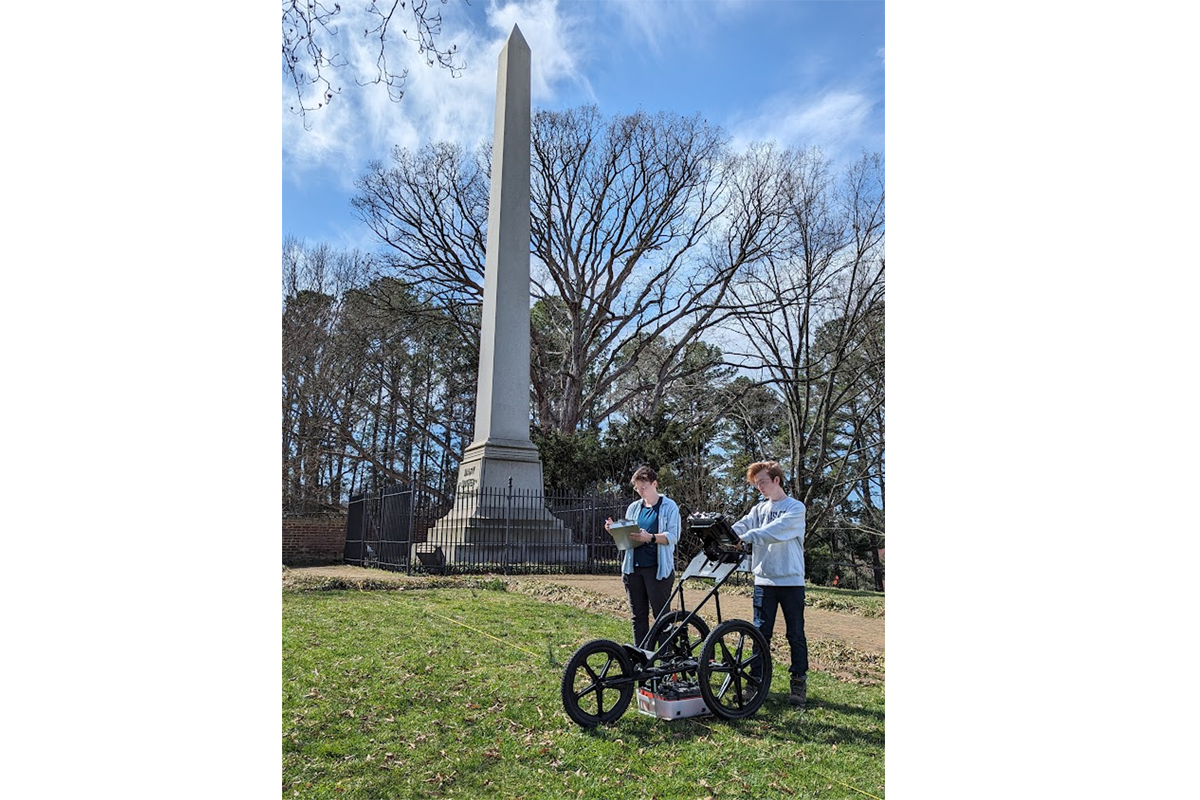
Katherine Parker, assistant professor of archaeology, joined UMW’s Historic Preservation Department in 2023. “I used GPR for a lot of other archaeology projects prior to being hired, and it is well-suited for finding burial sites with minimal ground disturbance,” Parker says. “It’s definitely a technology that’s in high demand, and teaching students how to use it will serve them as they go on in their profession.”
In February, WHM and UMW volunteers hosted a public day at the monument to demonstrate the GPR in use and answer questions about the project. Parker and her students pushed the device, which resembles a ruggedized stroller, in rows across gridded areas to collect data. “For every hour in the field, we spend five hours in the lab interpreting the data,” she says. The search will continue until all data has been analyzed. Rather than identifying specific objects, such as skeletal remains or casket fragments, the equipment reveals anomalies in the soil and general ground disturbances indicative of a gravesite.
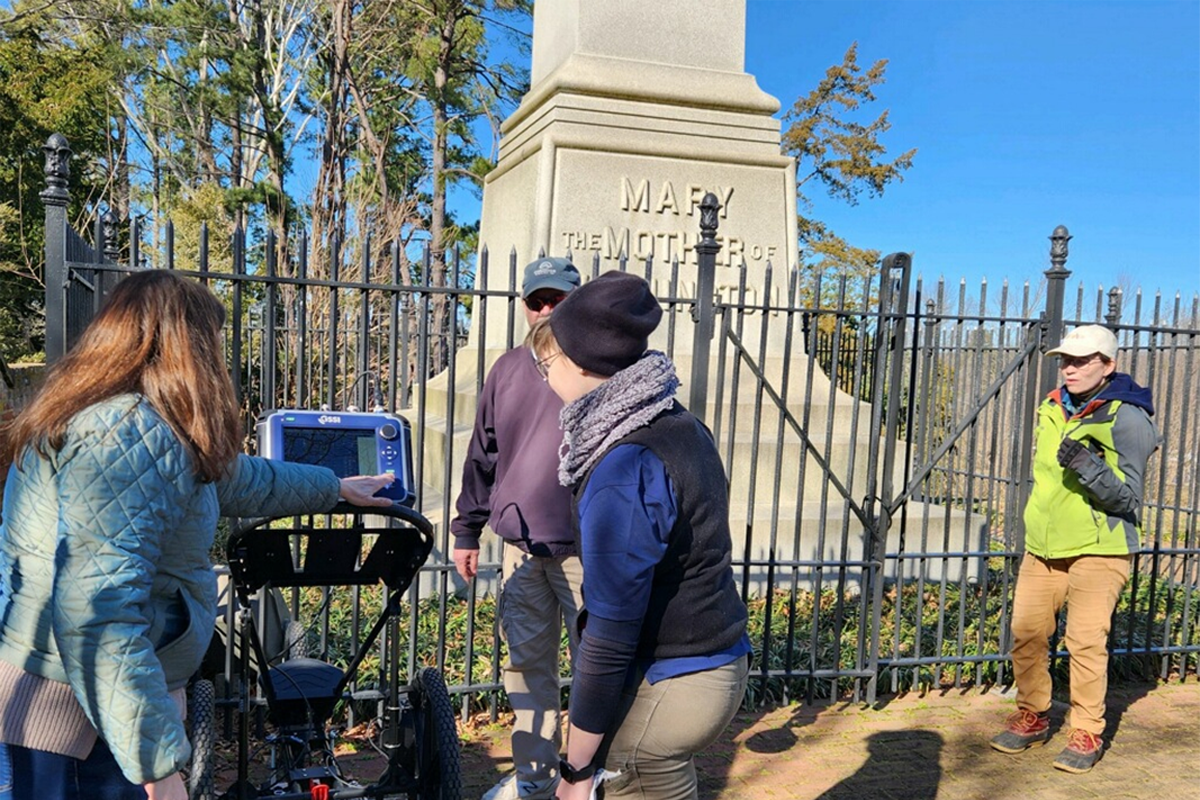
UMW sophomore and historic preservation major Blake Bauer has been assisting Parker. “I’m in an undergraduate research course with Dr. Parker, so not only do I get to be a part of this exciting project, but I’m also getting school credit for it,” Bauer says. “GPR is a valuable skill to have, especially as archaeology moves towards non-invasive approaches. Excavation is inherently destructive, so GPR is useful for searching burial sites.” So far, the team has noted some anomalies around the monument’s existing front pathway. “The lab is where we truly piece together the puzzle,” he says.
“This is hands-on experience I wouldn’t get anywhere else. Having the opportunity to search for the mother of our country, as well as my university’s namesake, makes things extra personal,” says Bauer.
“We may find Mary, or we may not, but either way I’m grateful to be part of the search and wouldn’t trade this opportunity for the world.”
Feature image courtesy University of Mary Washington
For more stories like this, subscribe to Northern Virginia Magazine’s News newsletter.