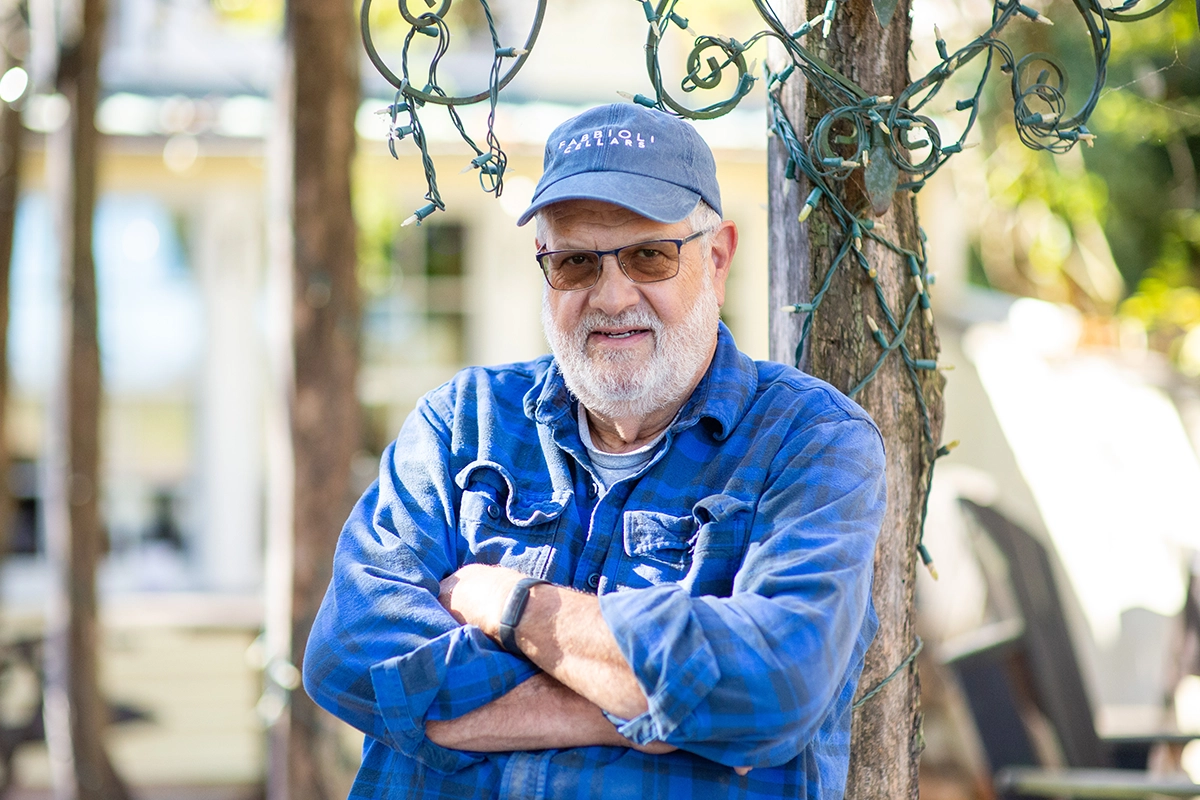
New York native Doug Fabbioli gleaned a passion for winemaking from his paternal grandfather, who produced wine in his basement. He’d seen how his grandfather made it a point to get to know the growers before purchasing their fruit, then meticulously sorted the grapes and kept wine lots separate. In 2004, after a decade in California, where Fabbioli worked in the cellar of Buena Vista Winery in Sonoma, took classes at the University of California, Davis, and learned to make his own wine, he and his wife, Colleen Berg, returned east and launched Leesburg-based Fabbioli Cellars. Today, they produce award-winning wines like cabernet franc and Tre Sorelle, a spicy and fruity blend of cabernet sauvignon, merlot, and malbec.

Throughout Fabbioli’s 40-year career in agribusiness, he’s learn invaluable lessons from his peers; not just winemaking, farming, and business, but also coaching, leadership, and self-awareness. Among those who’ve influenced Fabbioli are Jim Law, founder of Linden Vineyards in the eponymous town, whose philosophy about the scale of the business helped Fabbioli grow and make better wine, and David King, owner of King Family Vineyards in Crozet. Fabbioli served for eight years on the Virginia Wine Board with King, whose leadership style helped Fabbioli see the need to create a new agricultural initiative.
To foster and promote sustainable farming for future generations, he launched The New Ag School (NAS) in 2008. The initiative turned out to be an offshoot of his industry wine consulting and work with the Loudoun County Department of Economic Development to enhance rural NoVA businesses, where he trained others, taught classes, and encouraged leadership among the industry’s workforce.
NAS offers hands-on instruction coupled with classroom lessons focusing on reconnecting with nature and local food, preserving open spaces, and exposing how agritourism and farmers add value to the area. The school teaches agricultural skills and an appreciation for the work. Each student is paired with a mentor farmer who trains and may even employ the future leader.
“This program is a nod to those who fed my itch to learn and be mentored,” Fabbioli says. “Hopefully it’ll make it easier for younger folks to learn these subjects a little earlier, and a little easier.”

Industry Challenges
Going into agriculture today is not without its challenges. Increasing urbanization is a blight on the future of agribusiness, says Fabbioli. Because young people today aren’t often exposed to gardening, farming, raising animals, and other traditions of an agricultural-based economy, its future is in jeopardy. And when young people do enter the agricultural field, he says, rarely will the paycheck match that of other careers — generally paying $14 to $25 per hour.
“They need to be entrepreneurial from the start, even if they’re part of a family farm. Continuous mentoring is critical for success.”
Other ongoing challenges in the agricultural field, he adds, include fostering customer interest in products, recruiting and retaining good employees, unpredictable weather patterns due to climate change, and rising costs across the board.
Community Partnerships
The school’s Think Outside Program integrates with Loudoun County Public Schools by providing two-week programs at different points through the growing season and the school year. It introduces students to the many facets and logistics of agriculture-based careers including safety, work ethic, leadership, workplace culture, and team building — critical, on-the-job competencies that aren’t taught in traditional classrooms.
Mentors regularly work the farm, while those in other disciplines share their knowledge about the culinary arts, drones, permaculture, and farm markets. All offer first-time employment opportunities to eligible and available students.
Supraj Velagaj, a 16-year-old student who attended two sessions of the Think Outside Program last year, says that the “lessons with professionals, farm tours, and hands-on work really helped me learn about how agribusiness works and deepened my knowledge of where my food comes from.” Velagaj says his connections with fellow students and mentors turned to friendships and deepened his personal growth.

Earlier this fall, teenage students Jesus Roman and Mark Buzzell worked alongside Fabbioli harvesting raspberries. Afterward, they headed to the cellar and helped punch down the cap of grape skins, seeds, and stems to ramp up color, aroma, and flavor to a ferment batch of cabernet franc.
In addition to teaching students directly, Fabbioli rents part of his farmland to local tenants. One of them is Legacy Farms, a nonprofit that teaches life and job skills to 18- to 30-year-old neurodiverse members of the community. Neurodiverse apprentices can sign on for 10-week programs to tend to the flower garden. To raise funds, the nonprofit organization then sells flowers grown in the garden through its Legacy Blooms program. It also sells okra and peppers at area farmers markets. Legacy Farms offers its community members the opportunities to learn photography and social media marketing, sales and delivery, and garden space development. Fabbioli is often on hand to provide agricultural advice and guidance.
For adults, NAS provides classes and demos of farm-related subjects and careers like how to operate a bed-and-breakfast or work in a winery tasting room; all educational opportunities are promoted through the Virginia Farm Bureau and Virginia Cooperative Extension.
Fabbioli says obtaining insurance was one of the biggest challenges to getting the school off the ground. “We don’t fit into an easy box.” An ongoing hurdle has been overcoming some parents’ reluctance to encourage their children to enter the agriculture field. Many Loudoun County parents, he finds, want their kids to strive for the bigger salaries and less stressful lifestyles gleaned from high-tech careers and advanced degrees — and schools generally bury agriculture under environmental science. “Ag is all the trades plus entrepreneurship and lots of time in the dirt,” Fabbioli says. Still, he says, most parents are supportive when they see firsthand the school’s ethos and their child’s interest.
Since its founding, the school has slowly garnered community support from area nonprofits like 100WomenStrong, which provides grants to organizations like NAS that fulfill their mission to improve the quality of life for Loudoun County residents. “They see how our goals hit youth, education, environment, and community development,” Fabbioli says. Still, longer-term financial aid will help NAS expand its reach.

Leading the Way
The growth of Loudoun County’s agritourism economy shows how important it is to cultivate new talent. Wineries and breweries make up a substantial part of that economy, with 704 acres under vine and 3,000 in agricultural use. In 2023, a study commissioned by Visit Loudoun and conducted by Qualtrics and Aquino Consulting reported that 1 million people visited Loudoun’s wineries, breweries, and distilleries, and those businesses reported more than $48.6 million in revenue, a 60 percent increase since 2018. The study also found 85 percent of those in Loudoun’s beverage industry are county residents.
No matter where their agricultural path takes his students, Fabbioli believes having the guidance of adult leaders is critical. The school’s strong network of farmers and connection to associations and agencies helps build strong relationships with younger farmers and gives them the experience they need before becoming entrepreneurs.
“The New Ag School teaches these young folks to be coachable, and also to eventually coach and mentor others, as this is the key to the industry,” he says. “Land, equipment, labor, capital, and market for crops are all challenges that a good mentor can help a young farmer address. … We encourage hard, smart work for others before jumping out on your own.”
Feature image of Doug Fabbioli by Amie Otto
This story originally ran in our December issue. For more stories like this, subscribe to Northern Virginia Magazine.