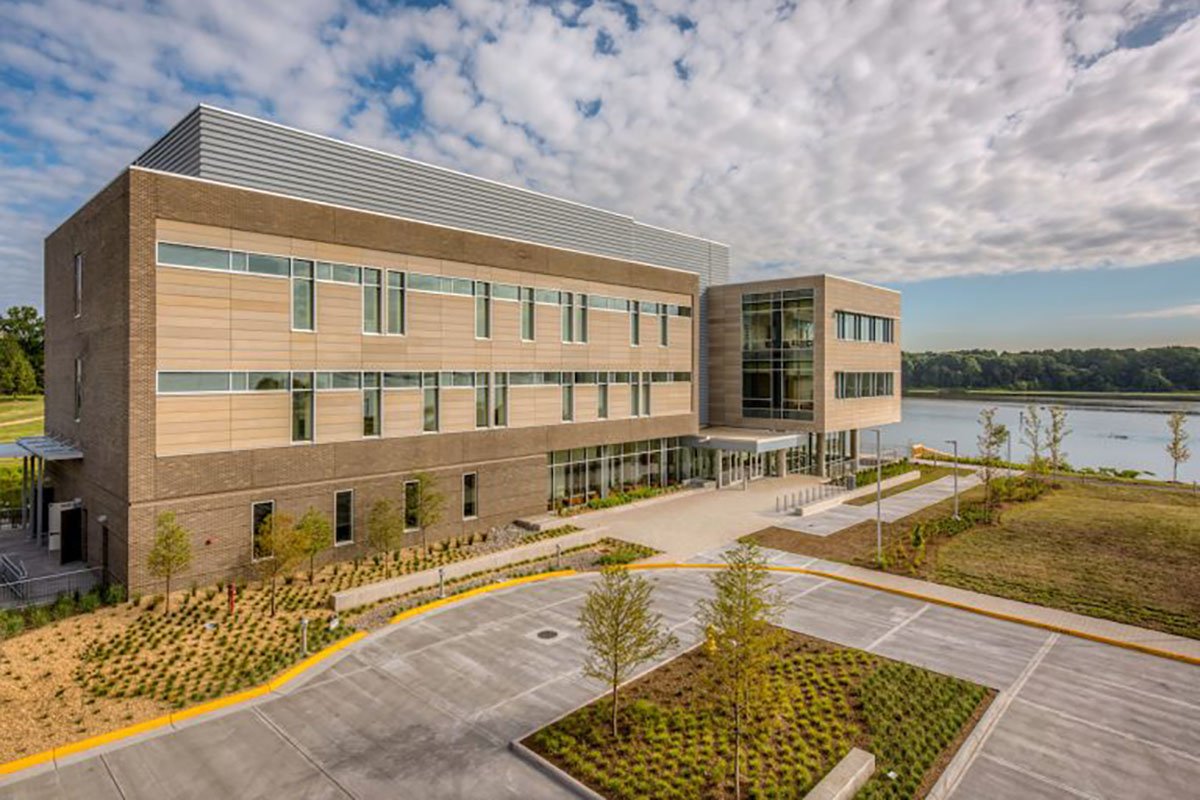
Nearly a quarter century in the making, George Mason University’s Potomac Science Center (PSC) at Belmont Bay on the Occoquan River is now open. The wait has been longer for Dr. R. Christian “Chris” Jones.
“Almost the entirety of my 35 year career at George Mason I’ve been trying to make this happen,” says the GMU professor and director of the Potomac Environmental Research and Education Center (PEREC), which has taken up residency at PSC.
After a couple of different organizations attempted to utilize the area, GMU began planning the center back in 1994. The Virginia government officially approved $5 million in appropriations in 2007, per a Washington Post report, and construction began on the $32 million facility in 2014. While the official building dedication took place on April 12, Jones says PEREC has been at the facility since last September, doing research and teaching students.
PSC is a 50,000-square-foot facility with wet labs, lecture rooms, offices, a spatial-analysis laboratory, a library resource center and an exhibit hall.
“It’s very much centered on the study of aquatic ecosystems,” says Jones. “We have chemists, we have geologists, we have biologists and water quality experts who are all working together.”
PEREC is currently the only permanent resident in the building, but another GMU-related program is expected to move in at some point in the future. Eight scientists make up PEREC, including Jones, and they are working on a number of different projects, like research contracts with both Fairfax County and Alexandria on the effects of their waste water on the Potomac.
At the moment, the center is primarily being used for research. Upper-level undergraduates and graduate students do have classes at the site, but the center is 30 minutes away from GMU’s Fairfax campus. There is a hope to expand on the teachings, including opening up specific elements to K-12 students. Jones says they have plans on developing summer camp programs at the facility as well.
“There’s not a huge amount to see right now, but we’re working on that,” Jones explains. “I think it’s a chance for Mason to go to the community and show that it’s accessible.”
PSC also intends to be a voice on the national and international stage.
“We want to stand out nationally and internationally as a home for research in this unique environment, which is tidal fresh water.” says Jones, specifically studying how humans are impacting the area, as well as the effects of climate change and pollution.