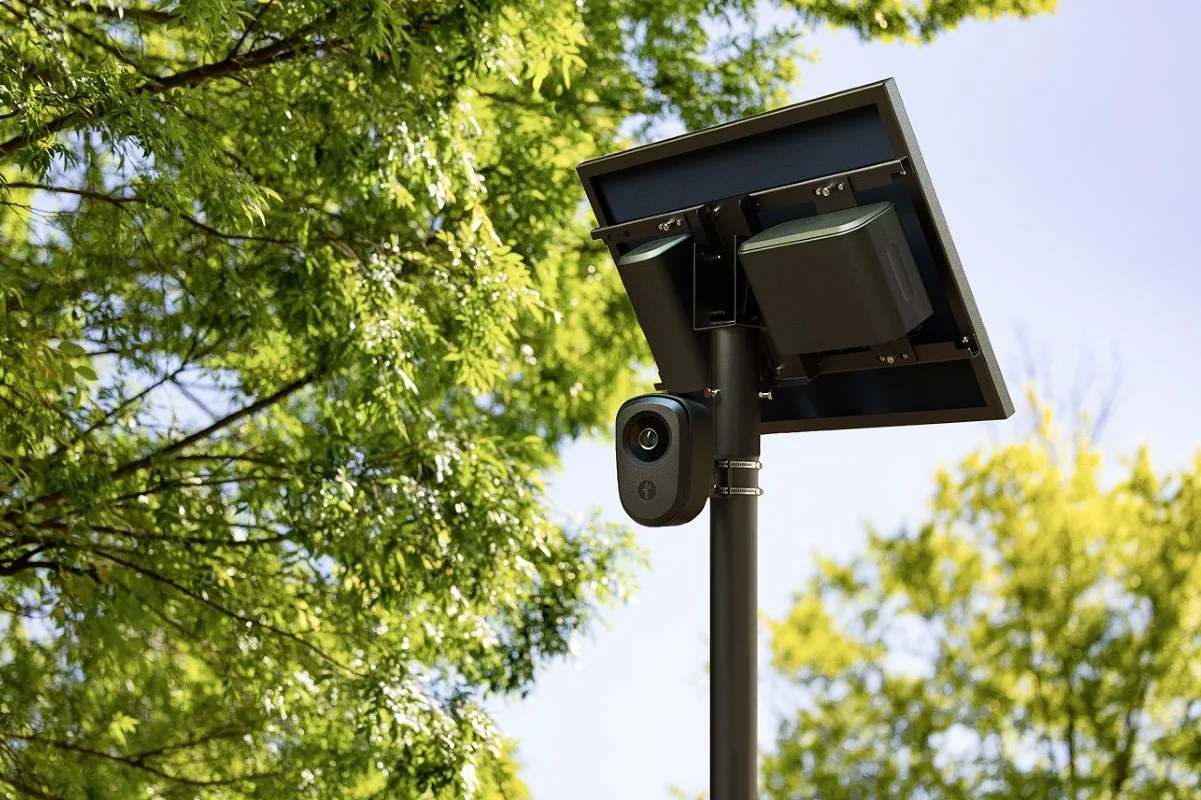
Fairfax County is one of a growing number of communities in which the police are using Flock cameras. The automated license plate readers (ALPRs) can track vehicles for the purpose of law enforcement and public safety.
The county is also one of a growing number of communities in which people are objecting to the cameras because of their encroachments on privacy.
Matthew Lofgren recently started DeFlock Fairfax because he says “a lot of us have expressed deep concerns about the invasions of privacy that ALPRs pose.”
What Are ALPRs?
A speed or red-light camera only takes pictures when a driver runs a red light or exceeds the speed limit. And these cameras are typically owned by the local or state police department.
Flock is a private company; their cameras are always recording, and they log each license plate and vehicle that they see. This information is then uploaded to databases which can be used to track the movements of any car over time — whether the driver is breaking the law or not.
Virginia’s Regulatory Policies
Virginia law says that the readers can only be used to track people in cases of violation of state or local law, missing people, and human trafficking. The information from the cameras must be deleted after 21 days, unless it’s being used in a legal case.
In other states, police officers have been accused — and convicted — of using the technology to stalk current and former romantic partners. Some law enforcement agencies have shared data with Immigration and Customs Enforcement. And some have explicitly been using the technology to track people involved in protests who are not accused of any crime.
A software developer “interested in digital privacy as a hobby,” Lofgren was spurred to action when he read a report last year from the Virginia State Crime Commission. Police agencies across the commonwealth were asked about their policies on ALPRs and the sharing of information from them. One-third of the agencies didn’t respond, and about 16% didn’t have a policy on the use of ALPRs, which the law says they must have.
The report doesn’t specify which departments are following the law and which aren’t. Fairfax County police say they do. They add that “FCPD does not get any LPR alerts regarding immigration enforcement warrants, driver’s licenses, registration, or inspection violations.”
Lofgren points out that the same law says that ALPR log data is not subject to Freedom of Information Act requests.
“FOIA requests are the way that journalists and citizens have discovered the abuses of ALPR cameras,” Lofgren says. “That’s how we found out that cops were stalking their ex-girlfriends. That’s how we found out they were surveilling protesters. That’s how we found out they were tracking a woman getting an abortion. And now in Virginia, you’re not allowed to issue FOIA requests for ALPR audit log data. So we don’t know how they’re being used.”
‘They Violate Our Privacy’
“They have a tool, and so they’re going to obviously use it,” Lofgren says. “Whether it was instrumental in helping solve the crime is an entirely different question,” Lofgren says. “We’ve been finding stolen cars for forever before the cameras came about.”
Lofgren adds that Denver saw a decrease in car thefts the month after they removed their ALPRs. And that Atlanta, the home of Flock Safety, has seen crime clearance rates decrease. “I don’t think there’s a whole lot of evidence to suggest that these are instrumental to solve crimes, but there is a lot of evidence to suggest that they violate our privacy.”
Lofgren says the tracking information Flock provides is a big problem.
“The simple fact of tracking every single car’s movements, everywhere they go, is itself a violation of privacy,” Lofgren says. “There is no suspicion of guilt. There’s no warrant required for this. It’s shared with hundreds of other agencies. It’s a gross violation of privacy.”
According to DeFlock Fairfax’s website, officials in five Virginia localities — the cities of Staunton and Charlottesville, the towns of Elkton and Warrenton, and Floyd County — have decided to cut ties with Flock and other ALPR providers.
Community Event
DeFlock Fairfax held an event August 22 at the Ravensworth Baptist Church in Annandale. Dr. Steven Keener, a board member of Justice Forward Virginia and director of the Center for Crime, Equity, and Justice Research and Policy at Christopher Newport University, spoke at the event.
Keener presented his research on ALPRs and the dangers he says they present. Lofgren says Keener showed that some ALPRs are mapped almost exactly with formerly redlined neighborhoods. (Redlining is a racially discriminatory and, now, illegal practice of devaluing homes in Black neighborhoods with few or no white residents.)
Lofgren estimated that about 100 people attended the event. And he says that afterward, more than half the crowd emailed their supervisors about the issue.
Fairfax County resident Alexandra E. says she attended the event because “I’m noticing these black poles with solar panels popping up more and more. … Places where you wouldn’t expect them – like schools and near business. Home Depot has four of them pointing at the store in the parking lot.”
Learning more about the cameras at the event, she said, “I just felt gross and sick in my stomach.”
But she was also inspired to “do what’s available, participate at a local level.” She attended her first Board of Supervisors meeting and says she was gratified to see “people from all different walks of life looking out for each other.” She says the board “seems to be responsive to all these people coming in.”
‘A Bipartisan Issue’
“This is definitely a bipartisan issue,” Lofgren says. “People on the left obviously dislike how ICE has been using it, how it’s been used to stalk No Kings protesters, women getting reproductive health care. But people on the right are very against “Big Brother.” I’ve heard my conservative dad say, ‘This is just like communist China, and they’ve been used to track people going to gun shows, people just exercising their second amendment rights.’ People of all stripes don’t like these things.”
Del. Irene Shin of Fairfax County says that, at minimum, the information on searches has to be made public.
“With all of the reports that we’ve seen, not only about officers who are misusing access to this data to track their exes, to stalk their ex-girlfriends, to pursue women who are seeking reproductive care, like abortions, the fact that we can’t even check to see who accessed this data and for what purpose seems insane to me,” Shin told Virginia’s Public Radio.
FCPD Statement
Fairfax County’s Police Department said its personnel “spend approximately 40 hours each month reviewing search activity and examining potentially abnormal patterns, questionable activity, or indicators of possible misuse. Each monthly audit is then presented to an FCPD commander for an additional level of review.”
The police said the technology has helped them file charges in 1,700 cases since 2022, including in a homicide. FCPS says it’s also helped them recover more than 500 stolen cars and locate 57 missing people.
“The potential misuse or abuse of technology is a serious concern and requires meaningful safeguards and oversight,” FCPD said in a statement. “FCPD has approached LPR technology with that responsibility in mind. Many of the safeguards now being discussed or recommended nationally, including documented search purposes, restricted access, mandatory training, recurring audits, supervisory review, limited data retention, enhanced audit tools, and public transparency were incorporated into FCPD’s program proactively, in some instances years before they became broader recommendations or requirements.”
They also detailed their process on their website.
Featured image courtesy Flock Safety