
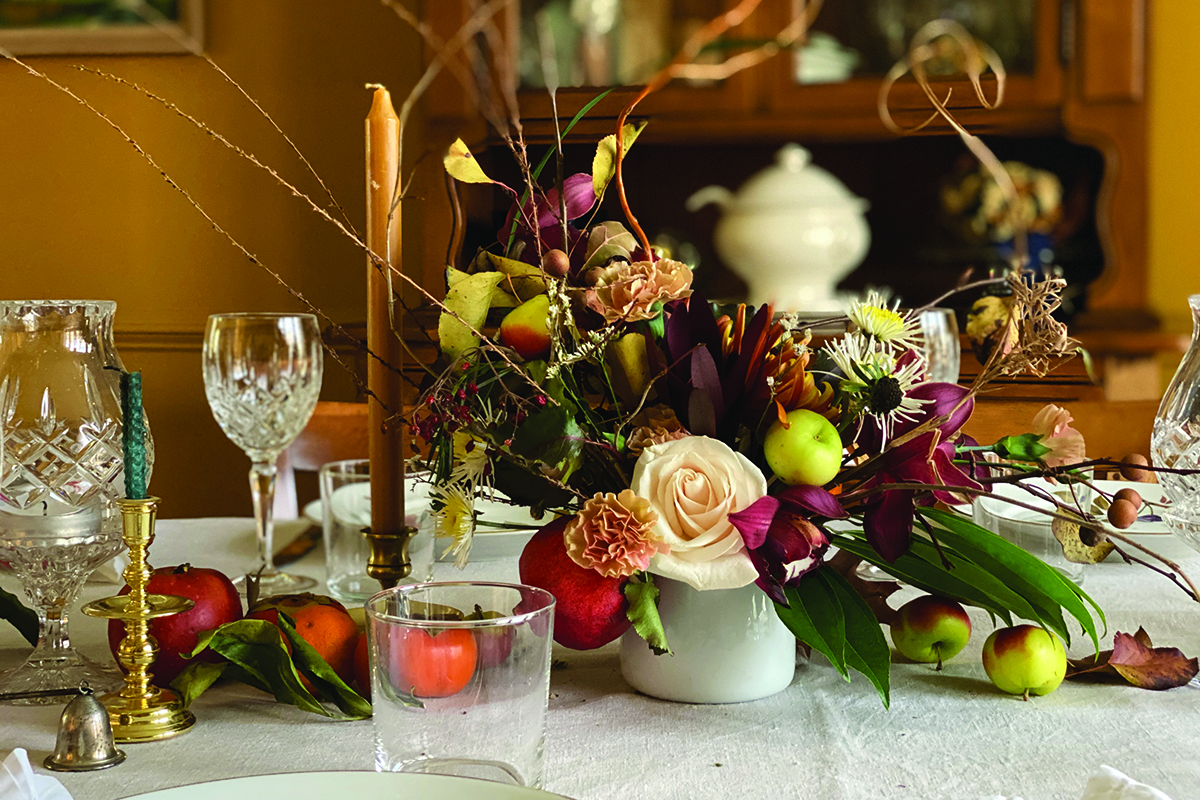
Holiday decorating starts out as a nice idea. Then you get gingerbread house glue stuck to your sock right before you run out of wrapping paper. We spoke to local pros who shared their advice on how to make trimming your home for the season more cheerful, less chore-ful.
Perfecting the Mismatched Table
When you think of place settings for the holidays, Emily Post might come to mind. Laura Hooper says there’s no need to get quite that technical, tediously adhering to every rule. A general planning session before loading up the table, however, is a good idea. “Diagrams online are helpful for making sure you put your silverware and stemware on the correct side, but don’t feel like you need to use everything they show in a diagram,” says the owner of Laura Hooper Calligraphy in Old Town Alexandria. “If you don’t have room for bread and a butter dish or don’t have them, you can just omit those from your tabletop.”
When it comes to deciding on a color scheme for your table, she says, “A good place to start is to look at your existing holiday décor items and make note of the colors used in those that you could pull from and put together cohesively.” Just Google “holiday color palette,” suggests Hooper, and you’ll see a variety of options that go way beyond red and green or blue and silver.
“Pulling in a mustard color paired with burgundy and evergreen is a simple example,” she says, “and would work with any gold elements that you already have on hand.” When it comes to the rules of formal dining, Hooper says, “I would say the only rules come from your own comfort level with mix-and-match pattern play. Ultimately, you want the design to go together, so keeping in similar tones and patterns that don’t overtly clash is a good idea.”
As far as linens are concerned, she says, “If I’m doing patterned plates and patterned napkins, I’ll go more neutral on the table—even no linen, if that’s an option, like shown in the photo. You can always scale back or swap in a plain napkin if it all looks too much when you step back and take a lot at the tabletop as a whole.”
Creating an Easy Centerpiece
Finding materials for the center of your table doesn’t have to become an all-consuming quest, says Anna Rice, who assembles gorgeous tableaux for her Northern Virginia–based floral business, Studio Fleuraison. Many items can be sourced right in your backyard.
“This is the season where plants are making berries, like nandina, holly, or privet,” says Rice. “I often work with citrus, greenery, and berries for Christmas. I will bring in grasses that have a silvery or gold tone, and you can dry them and hang onto them for décor later.”
When it comes to color, Rice likes to veer from the traditional toward orange and green hues—which, as a bonus, are easy to find during the holidays. “These colors are seasonally appropriate because that’s what’s going on in the natural world,” she says. “Dried flowers are having a moment of being on trend, and the tones of the dried elements often go well with the traditional dark green. I think this season is good to be innovative but also recognizably festive.”
Making the Modern Merry Garland
Sharla Bond of C&S Farmstead, a family-owned farm in Fauquier County, says, “You can find an abundance of vines, greens, berries, and grasses if you enjoy wild harvesting.” Just be careful, she cautions, to know what poison oak looks like before attempting this. If you’re in a place where you can’t find these things easily, you can also contact flower growers, who are always on the lookout for these types of items, or source things such as eucalyptus garlands from local floral wholesalers who sell to the public.
To DIY a garland out of loose branches, says Bond, “You basically need some floral wire (found at any hobby store) and a good pair of garden or floral snips. Laying out your greenery piece by piece, you can wire the denser pieces of the branches together and leave the thinner branches dangling in order to have a fuller look. Filling in blank spaces with dried flowers such as baby’s breath or holly berries will help you complete your look. As far as draping the garlands, you can use small nails, removable sticky hooks, pipe cleaners, or wire.”
Wrapping it Up
With gift wrap, a lot can go wrong. You might run out of paper just as you’re finishing your last gift, or you can butcher the wrap job from start to finish. Sarah Hitchcock Burzio, owner of Hitchcock Paper Co. in Occoquan, says, “Pattern-matching can be frustrating when gift-wrapping. Ninety-degree angles are your friend for keeping things straight. If you have an item that just won’t wrap, consider putting it into a box to make it easier.”
When it comes to selecting wrap so your presents don’t all look the same under the tree, she says, “Buy four or more complementary, but not identical, gift wraps. Don’t be afraid to mix plaids and patterns of the same color scheme to give it some texture and interest. I do recommend having a solid neutral, such as brown kraft or a red shimmer, to add a resting place for your eye amongst heavily patterned papers.”
The last thing you want is for the paper you grab from the drugstore to look lackluster when compared with something else under the tree. Burzio recommends buying better-quality gift wrap, and it isn’t just for looks—premium paper makes things easier on you because it tears much less easily than the cheap stuff. “We’re also big fans of folding the raw edges over at the seam and using a tape runner or double-sided tape for a seamless finish,” says Burzio. “Our favorite pro tip is to create the seam on the top of the present, then use a thick ribbon to cover it—no need to worry about patterns matching up.”
Feature image courtesy Studio Fleuraison
This story originally appeared in our December issue. For more stories like this, subscribe to our monthly magazine.