It’s not surprising that the leading meditation misconceptions, according to Sunny Yeo of Arlington Meditation, are “I don’t have time,” “I can’t sit still” or “My mind can’t sit still.” “When our minds are busy, we become disconnected from our bodies,” says Paula Pierce, owner and master instructor of Body & Brain of Vienna. “By reconnecting, we strengthen the inner-dialogue creating the opportunity for physical and emotional healing and spiritual growth.”
Fortunately, the region offers abundant opportunities for this.
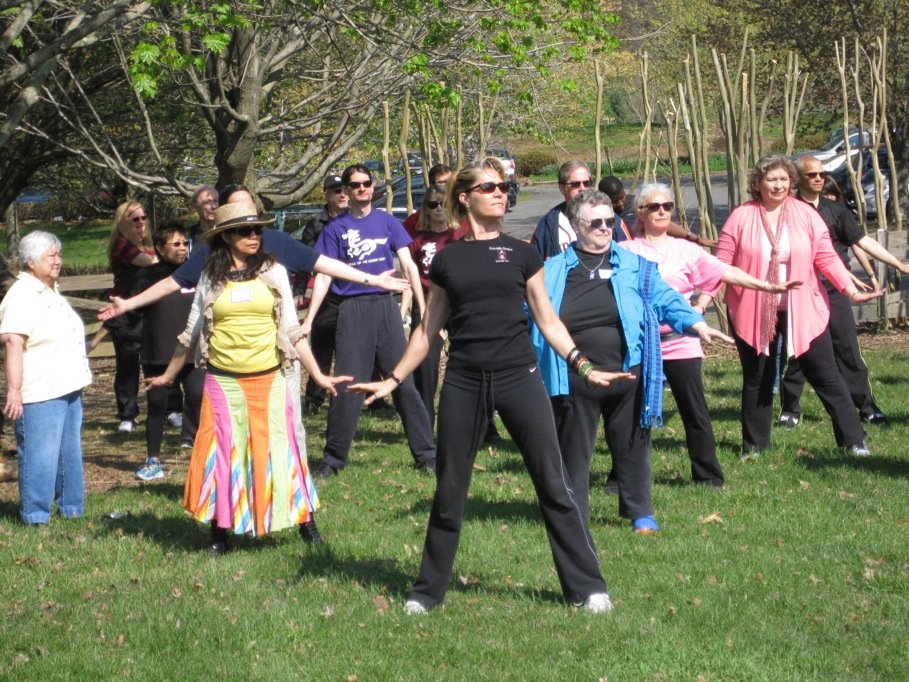
Tai Chi, an ancient Chinese tradition rooted in Taoism, is a mind-body-spirit practice that translates to “big energy” and includes internal martial art and self defense applications. “We seek to find motion in stillness and stillness in motion. Tai Chi is practiced standing—ideally with an unbroken motion from the beginning of the form to the end,” Kris Brinker, founder of Just Breathe and lead instructor at Peaceable Dragon Instructors Association, says.
Moving meditation yields wide health benefits including improved joint health, reduced headaches and reduced reliance on medications for chronic conditions such as high blood pressure, diabetes, asthma and digestive conditions. “It’s reported that 70-90 percent of doctor visits are stress related. With stress, our bodies become out of balance and rhythm,” Pierce says. The practices are also known to prevent and reverse health conditions related to aging, such as arthritis, Parkinson’s and preparation for fall prevention.
While some of the meditation has religious and cultural origins, the evolved practice does not exclude anyone regardless of age, religion or health restraints. Tai Chi “keeps one foot in the tangible world, fortified by the other foot in the intangible. It is the embodiment or ultimate human expression of Yin-Yang in life,” says Stephan Berwick of True Tai Chi.
There are many variants of moving meditation, which all are cultural forms that involve connecting to energy inside and around the individual practicing. Ki Gong, which translates to “expanding energy” in Korean and is also known as Qigong, is the parent of Tai Chi and has less of a martial arts emphasis. Reiki, a Japanese technique that uses the chakra system and life force energy flowing through the body, has been described as “acupuncture without the needles” for its ability to increase relaxation and reduce stress. Danh Mu is “energy dance,” which involves feeling universal energy and allowing the body to move in concert with that energy.
For those more interested in stationary meditation, Transcendental Meditation aims for pure consciousness through the natural and effortless technique of sitting comfortably with the eyes closed for 20 minutes a day, twice a day. “As paradoxical as it may sound, TM is profound because it is easy,” says Dr. Jamie Grant, director of Transcendental Meditation Center in Fairfax. “All of the benefits that come from TM come from the mind settling deeply to a state that researchers have called ‘restful alertness.’”
Throughout the day in the wakeful state, our brain waves operate at 15 to 30 oscillations per second. Meditation begins when the rhythm slows to nine to 14 waves per minute. “Fresh creative energy begins to flow, fears vanish and you experience a liberating sense of peace and well-being,” Pierce explains. “At this state you begin to access the wealth of creativity that lies just beneath your conscious awareness.”
We all rely heavily on our five senses in our day-to-day life. “During meditation, we move beyond the five senses and tap into our sixth sense, that internal compass. The sixth sense is like a muscle, the more you use it the stronger it gets. With practice, we can transition our reliance on external information to determine our path and gauge our performance, and rely on our own internal consciousness to create the life we desire,” Pierce says.
Meditation is championed as a natural and holistic solution to psychological and emotional distress, as well as a means to discover and clear the roots of them. Those who practice are left with “fundamental inner strength and confidence, which means we can become resilient and determined in life. We will also be able to see more realistically and positively and thus behave accordingly,” Yeo says.
While meditation is an individual journey, those who practice yield much wider results. “Meditation helps keep families together, and helps coworkers and neighbors to become more understanding and kinder,” Yeo says. “This all translates into a harmonious community of people who work hard for each other. Peace and coexistence as a way of life could become a reality once people reflect on themselves, discard out the false negativity and attain the true inner peace.”
Regardless of what form of meditation is right for you, the instructors emphasize the most important factor is that you practice. “When you feel good, you do good,” says Pierce. “People who are facing difficult physical, emotional or mental conditions must focus on themselves in order to improve their conditions. When we improve our conditions through meditation, we are able to help others in bigger and better ways. It’s the oxygen mask principle—put yours on before helping others. Meditation is important to creating a society of health, happiness and peace.”
The studios encourage residents of Northern Virginia to get outside as much as possible. Berwick suggests: “Enjoy the heat, the cool, the dry, the wet, all with an aware body and mind of finely-tuned senses.”
If you are seeking the balance and serenity that meditation or Tai Chi offers but doubtful of your ability, Pierce offers guidance: “Don’t be afraid of it and don’t give up. If you try meditation and your monkey mind keeps getting filled with thoughts or emotions, just acknowledge them and let them go. It doesn’t mean you can’t meditate—it simply means you need to keep trying.”