By Josh Weiner
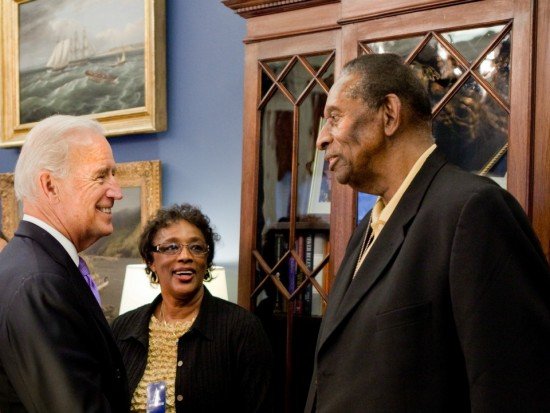
Earl Francis Lloyd died one year ago this month. The “Jackie Robinson of basketball,” he was a game-changer for black athletes in Northern Virginia and across the country. “Being one of the first African-American players in the NBA, he broke down racial barriers not only for players, but also in management and coaching,” says Audrey P. Davis, director of the Alexandria Black History Museum.
Lloyd has a long legacy in Virginia: He was inducted into the Virginia Sports Hall of Fame in 2003, recognized by the Library of Virginia as one of the Strong Men and Women in Virginia History and honored by T.C. Williams High School in Alexandria when the school named its newly constructed basketball court after him in 2007.
Born in Alexandria on April 3, 1928, Lloyd had a standout basketball career at Parker-Gray School, which is located at the current site of the Charles Houston Recreation Center. He went on to play for West Virginia State College and earned his bachelor’s degree in 1950; the same year, Lloyd became one of the first three black players to make it to the NBA.
Chance played into the different distinctions which each of these three men now hold. Chuck Cooper was the first of the three to be selected in the draft (by the Boston Celtics in the second round), while Nat “Sweetwater” Clifton beat the others to an NBA contract when he signed with the Knicks. However, given that Lloyd’s Washington Capitols had an early start to the season, he officially became the first black player to appear in an NBA game on Halloween in 1950, scoring six points in a loss to the Rochester Royals.
“[They] were the first black players to be drafted, to be signed and to play in the NBA,” Christopher C. Elzey, history professor at George Mason University, says of Cooper, Clifton and Lloyd. “Those are lesser-known stories, I think, that need to be promoted and celebrated.”
Lloyd went on to a solid nine-season NBA career, averaging 8.4 points per game in 560 contests while missing two years to serve as an private in the army at Fort Sill, Oklahoma. He played for the Capitols, Syracuse Nationals and Detroit Pistons during that period; after his retirement, he joined the faculty of the latter as an assistant coach, becoming the first black person ever to do so. Lloyd was later promoted to head Pistons coach in 1971, though his coaching record for the team (22-55 over two seasons) was less than glamorous. He eventually took on positions at the Detroit Board of Education and as an automotive executive during his post-sports career.
Although Lloyd spent much of his later life in Tennessee, where he died on Feb. 26, 2015, he is still worth remembering as one of Northern Virginia’s pivotal cultural figures. “If there was ever a true ambassador for the game, it’s Earl Lloyd,” said Dave Bing of his former Detroit Pistons teammate at the NBA Hall of Fame Induction Ceremony in 2003.